
Security and customer operations · October 6, 2026
Telegram customer data access control: roles, teams, and scope
A support team should be able to answer a simple question before anyone opens a customer record: why does this person need access, and how much access is enough?
Why a shared Telegram account is not an access model
Putting several people behind one login makes it difficult to know who viewed a customer, which team owns the relationship, or when access should end. It also turns a routine staffing change into a manual password and session exercise.
A more durable model separates four questions: which function someone performs, which organization data they may see, which customer or channel they own, and whether a sensitive action needs an additional review.
Four layers of practical access control
1. Named role and function
Give each employee a named account and a role that matches their work. Customer support, team management, and security review should not all receive the same administrative access. A role answers what a person may do; it should not automatically grant access to every customer.
2. Organization and data scope
Use the department or organization scope to limit which business data is in view. Scope is especially important when several teams share the same COnnect workspace. Review scope when someone moves departments, changes responsibilities, or leaves.
3. Customer and channel ownership
Assign an accountable owner to each active customer relationship and company Telegram channel. Ownership makes the next action visible without turning a handoff into unrestricted browsing. For supported Telegram customer and group records, COnnect uses ownership information when applying organization scope.
4. Time-limited review for higher-risk work
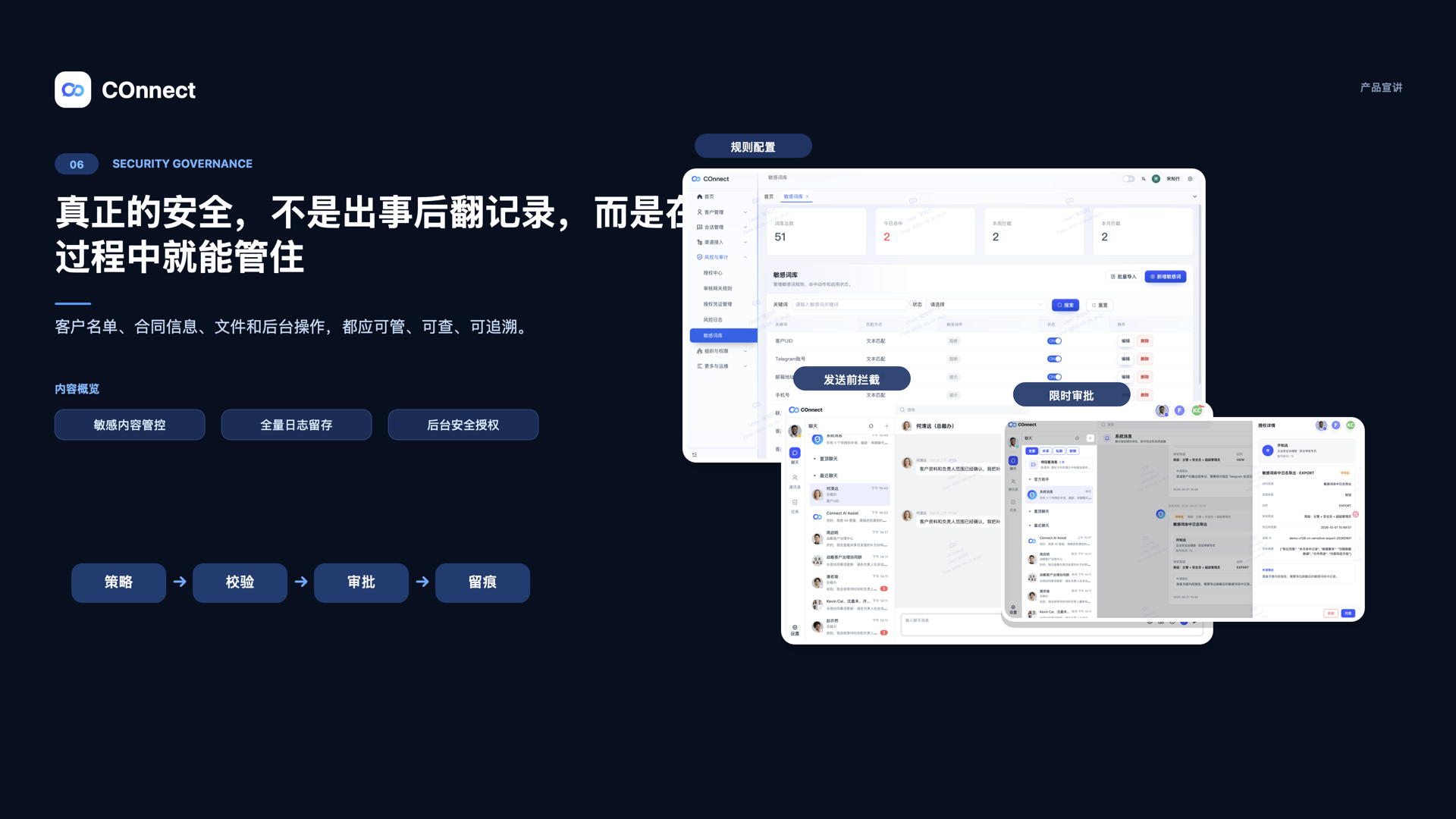
Some operations need more than a standing role. The safer sequence is: the user has the required long-term permission, the action matches a configured review rule, the request is approved, a valid credential is issued, and the decision is recorded. A request should not silently widen someone's normal access.
What to review when a teammate changes role
Start with the employee's department and role, then review owned customers, company Telegram channels, pending replies, open follow-up work, and any active approval or review access. Transfer the business relationship to a named teammate, keep the context needed to continue service, and remove permissions that are no longer justified.
For a departure, access removal is only half the job. The receiving teammate needs a clear owner, next action, and relevant customer context so the customer does not have to repeat the conversation.
How COnnect supports the model
COnnect provides organization roles, data-scope controls, customer and channel ownership, permission-opening requests, and supported approval or risk-review workflows. The mobile and PC Web clients expose a security assistant entry for approval tasks. Current controls apply to supported COnnect workflows; they do not claim that every Telegram action or message is automatically audited.
For the operational steps, see the customer ownership guide, the company Telegram accounts guide, and the governance approval guide.
FAQ
Does a role give an employee access to every Telegram customer?
No. A role describes permitted functions. Organization data scope and customer or channel ownership still determine which supported records are in view.
What happens when an employee needs a higher-risk action?
When a configured review rule applies, the user must follow the supported request and approval flow. Access is granted only after the required approval and credential checks succeed.
Can COnnect replace Telegram's own account security?
No. Telegram session, recovery, and Two-Step Verification settings remain Telegram account responsibilities. COnnect adds organization and customer-operation controls around supported workflows.
Make access decisions explainable.
See how COnnect connects roles, organization scope, customer ownership, and controlled review.
Talk to the enterprise team