
Customer operations · September 10, 2026
How to manage Telegram customer conversations as a team
Telegram can be a fast customer channel, but a personal inbox is not a reliable operating model for a growing team. The goal is to keep ownership clear, access intentional, and follow-up visible.
Why team Telegram operations become difficult
When customer conversations stay inside individual accounts, managers cannot easily see who owns a relationship, whether a reply is pending, or what should happen when someone changes role. The risk is not only slower replies. It is also inconsistent service, unclear accountability, and customer history that leaves with one person.
A practical operating model
1. Define the company channel boundary
Start by separating company Telegram accounts from personal employee accounts. A company channel should have an accountable owner, an approved purpose, and a clear rule for who may handle its conversations.
2. Assign conversation ownership
Every active customer conversation should have a current owner or an explicit queue. Ownership is a business responsibility, not a blanket grant to browse every customer record.
3. Use controlled handoffs
When a customer moves between teams, record the new owner and the reason for the handoff. Keep the recent customer context, labels, notes, and open follow-up visible so the next teammate can continue without asking the customer to repeat everything.
4. Make pending replies visible
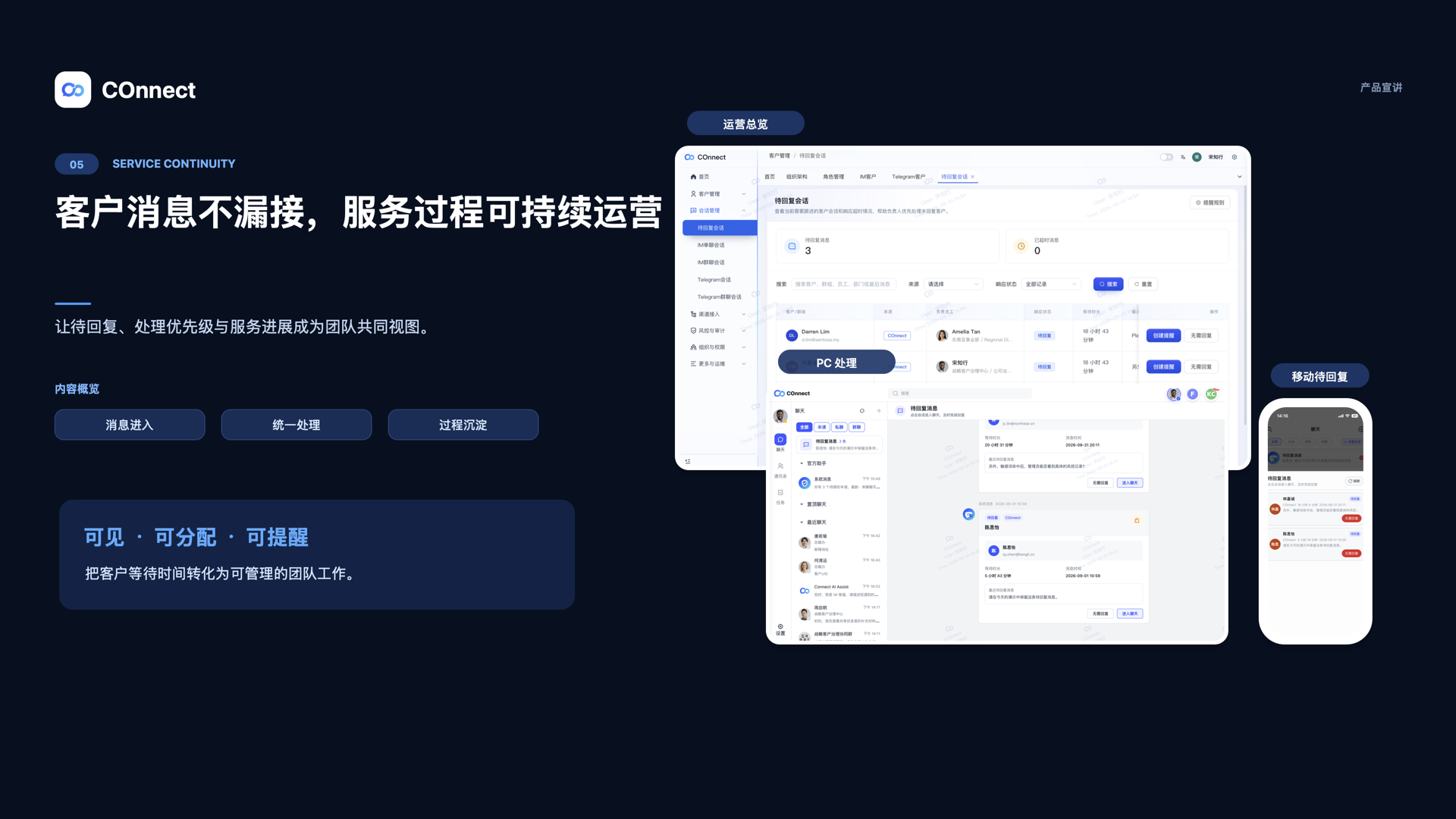
A notification is not the same as a completed response. A useful pending-reply workflow shows which customers are waiting, what the latest activity was, and whether the next action is a reply, an assignment, or a task.
A teammate may need to handle one conversation without needing unrestricted access to the entire connected account.
Questions to ask before choosing a workflow
- Can a manager see the current owner without asking the team?
- Can a handoff preserve customer context and the next action?
- Can the organization limit access by role and data scope?
- Can the team distinguish a sent reply from a failed or pending action?
How COnnect supports this model
COnnect combines company-channel management with organization roles, data-scope controls, customer ownership, pending-reply visibility, and task follow-up across supported clients. The point is not to replace Telegram; it is to make customer communication a team process that can be reviewed and improved.
FAQ
Should every employee use the same Telegram account?
Not necessarily. The important distinction is between a company-owned channel with controlled access and an employee's personal account that the organization cannot reliably govern.
What should happen when an employee leaves?
Review active ownership, transfer customer conversations and follow-up tasks, remove access that is no longer needed, and keep the handoff record visible to the team.
Build a more accountable customer communication workflow.
See how COnnect brings customer conversations, ownership, permissions, and follow-up into one governed workspace.
Talk to the enterprise team